
-- Canadian actor William Shatner (1931-), in the voice-over introduction to the television series Star Trek in its debut episode, 8 September 1966. I previously blogged this same quote 10 years ago today, for the 50th anniversary
-- Canadian actor William Shatner (1931-), in the voice-over introduction to the television series Star Trek in its debut episode, 8 September 1966. I previously blogged this same quote 10 years ago today, for the 50th anniversary

-- CSA (Canadian Space Agency) astronaut Jeremy Hansen aboard NASA's Orion spacecraft during the Artemis II test flight around the Moon, traveling 248,655 miles from Earth, surpassing the record for human spaceflight's farthest distance previously set by the Apollo 13 mission in 1970 (6 April 2026)

The first crewed deep-space flight in over 50 years, Artemis II is expected to send the crew farther from Earth than any previous human mission, potentially breaking the record of about 248,655 miles (400,171 km) from Earth set by Apollo 13 during its lunar free-return trajectory. This milestone will occur during the lunar flyby phase, when the crew travels on a free-return trajectory around the Moon, which allows the spacecraft to loop around the Moon and return to Earth without entering lunar orbit.
During the test flight, NASA will test life-support systems and critical operations in deep space, paving the way for future lunar landings and Mars exploration.
-- Jason Costa at Nasa.gov, "LIVE: Artemis II Launch Day Updates" (1 April 2026)
.jpg)
-- Dr. Steve Pearlman, author, instructor, and martial arts philosopher, The Book of Martial Power (2006) Chapter 69 "Yin and Yang" p. 210

-- James Arthur Lovell Jr. (25 March 1928 - 7 August 2025), American astronaut, naval aviator, test pilot and mechanical engineer, In the Shadow of the Moon (2007 film)
.jpg)
Product(s) or Data Impacted: All Defense Meteorological Satellite Program (DMSP) data and products: FINE, SMOOTH and HOUSEKEEPING data from Operational Linescan System (OLS), Special Sensor Microwave Imager Sounder (SSMIS), and all Near-Earth Space Weather instruments
Date/Time of Initial Impact: no later than June 30, 2025
Date/Time of Expected End: NA Termination
Details/Specifics of Change:
Due to recent service changes, the Defense Meteorological Satellite Program (DMSP) and Navy’s Fleet Numerical Meteorology and Oceanography Center (FNMOC) will discontinue ingest, processing and distribution of all DMSP data no later than June 30, 2025. ESPC interfaces will not receive DMSP data and all data products will be suspended. Users should expect all FINE, SMOOTH and HOUSEKEEPING data from Operational Linescan System (OLS), Special Sensor Microwave Imager Sounder (SSMIS), and all Near-Earth Space Weather instruments to be terminated. This service change and termination will be permanent.
-- Notice published by the National Oceanic and Atmospheric Administration, NOAA (25 June 2025), announcing that after 40 years, on 5 days' notice, the U.S. Department of Defense will no longer provide satellite weather data, leaving hurricane forecasters without crucial information about storms as peak hurricane season arrives in the Atlantic. The termination has been delayed by 1 month after an outcry from scientists and forecasters, NPR "Defense Department will stop providing crucial satellite weather data" (1 July 2025)

And what do we get for that? The Universe.
Missions to Mercury, Venus, Jupiter. Landers on Mars, telescopes that peer through the depths of the cosmos, a fleet of spacecraft monitoring the Sun, the star to which we owe our existence. The abject awe and wonder of images of a glorious cosmos. The first A in NASA is for Aeronautics, too; research that makes air travel better, faster, and safer. NASA science includes observing and monitoring our own planet as well, making satellites that track our water, atmosphere, and land. NASA scientists study climate change, one of the single biggest existential threats to humanity.
NASA employs about 18,000 people across all 50 states (and that doesn't include contractors, of which I was one for many years, and people such as academics who have NASA grants). NASA partners with space agencies around the world, a diversified portfolio that guarantees the best scientific research always pushing past the cutting edge and accelerating our understanding of, well, everything.
-- Philip Plait, Bad Astronomy Newsletter, "Trump threatens to eviscerate NASA" (2 June 2025)

-- Frank Borman, II (1928 - 2023), United States Air Force (USAF) colonel, aeronautical engineer, test pilot, businessman, rancher, and NASA astronaut, commander of Apollo 8, Prayer from Apollo 8, on Christmas Day (25 December 1968)

-- William Alison Anders (17 October 1933 - 7 June 2024), former American astronaut, who flew as Lunar Module Pilot for the Apollo 8 mission (although no lunar module was carried by the mission), the first mission where humans traveled beyond Low Earth orbit, "50 Years After 'Earthrise,' a Christmas Eve Message from Its Photographer" Space.com (24 December 2018)

The most distant spacecraft from Earth stopped sending back understandable data last November. Flight controllers traced the blank communication to a bad computer chip and rearranged the spacecraft's coding to work around the trouble.
It takes 22 1/2 hours to send a signal to Voyager 1, more than 15 billion miles (24 billion kilometers) away in interstellar space. The signal travel time is double that for a round trip.
Launched in 1977 to study Jupiter and Saturn, Voyager 1 has been exploring interstellar space since 2012. Its twin, Voyager 2, is 12.6 billion miles (20 billion kilometers) away and still working fine.
-- Marcia Dunn for Associated Press, "NASA hears from Voyager 1, the most distant spacecraft from Earth, after months of quiet" (23 April 2024)

We had about 98% totality here. At the start of the event the temperature was in the low 70s, and the sun provided plenty of warmth. The light in the sky changed noticeably with a little over 30 minutes to go, and continued to diminish with an eerie dimming that didn't quite match the clear sky and sun. The loss of the sun's warmth was even more dramatic.


-- Intuitive Machines Chief Technology Officer Tim Crain, on the success of their lunar lander Odysseus, which today became the first US vehicle on the moon since Apollo 17 in 1972, New York Times, 22 February 2024
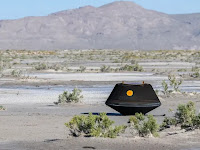
-- Dante Lauretta, planetary scientist at the University of Arizona and leader of NASA's OSIRIS-REx mission, after the successful recovery of samples taken from asteroid Bennu in a mission that launched in 2016, 24 September 2023
_of_SDSC-SHAR,_Sriharikota_03.webp)
-- Indian Prime Minister Narendra Modi, in comments on the success of India's Chandrayaan-3 lunar mission, launched July 14th. The mission cost just $75,000,000, and today successfully deployed a lunar rover, 25 August 2023

-- NASA's InSight (Interior Exploration using Seismic Investigations, Geodesy, and Heat Transport) lander, which has been conducting scientific explorations on the Martian surface for nearly four years, 11 December 2022

-- Eugene Andrew "Gene" Cernan (1934 - 2017), American astronaut, naval aviator, electrical engineer, aeronautical engineer, and fighter pilot, eleventh and final human being to walk on the Moon, on his final lunar excursion, 14 December 1972

-- Clarence William Nelson II (1942 -), American politician and attorney serving as administrator of the National Aeronautics and Space Administration (NASA), congratulatory message to NASA teams, after the successful impact of the DART spacecraft into the moonlet Dimorphos of the asteroid Didymos, (26 September 2022)

We're going back to the Moon for scientific discovery, economic benefits, and inspiration for a new generation of explorers: the Artemis Generation. While maintaining American leadership in exploration, we will build a global alliance and explore deep space for the benefit of all.
We will build an Artemis Base Camp on the surface and the Gateway in lunar orbit. These elements will allow our robots and astronauts to explore more and conduct more science than ever before.
All that we build, all that we study, all that we do, prepares us to go.
-- NASA, on their home page for the Artemis project, retrieved 29 August 2022

Thousands of galaxies – including the faintest objects ever observed in the infrared – have appeared in Webb's view for the first time. This slice of the vast universe is approximately the size of a grain of sand held at arm's length by someone on the ground.
This deep field, taken by Webb's Near-Infrared Camera (NIRCam), is a composite made from images at different wavelengths, totaling 12.5 hours – achieving depths at infrared wavelengths beyond the Hubble Space Telescope's deepest fields, which took weeks.
The image shows the galaxy cluster SMACS 0723 as it appeared 4.6 billion years ago. The combined mass of this galaxy cluster acts as a gravitational lens, magnifying much more distant galaxies behind it. Webb's NIRCam has brought those distant galaxies into sharp focus – they have tiny, faint structures that have never been seen before, including star clusters and diffuse features. Researchers will soon begin to learn more about the galaxies' masses, ages, histories, and compositions, as Webb seeks the earliest galaxies in the universe.
-- NASA's announcement of the first publicly released image from the James Webb Space Telescope, 11 July 2022

"Webb, welcome home!" NASA Administrator Bill Nelson said in a statement Monday. "We're one step closer to uncovering the mysteries of the universe. And I can't wait to see Webb's first new views of the universe this summer!"
-- Nicole Karlis, James Webb Space Telescope: When to expect the first images from the state-of-the-art observatory, salon.com, 26 January 2022

